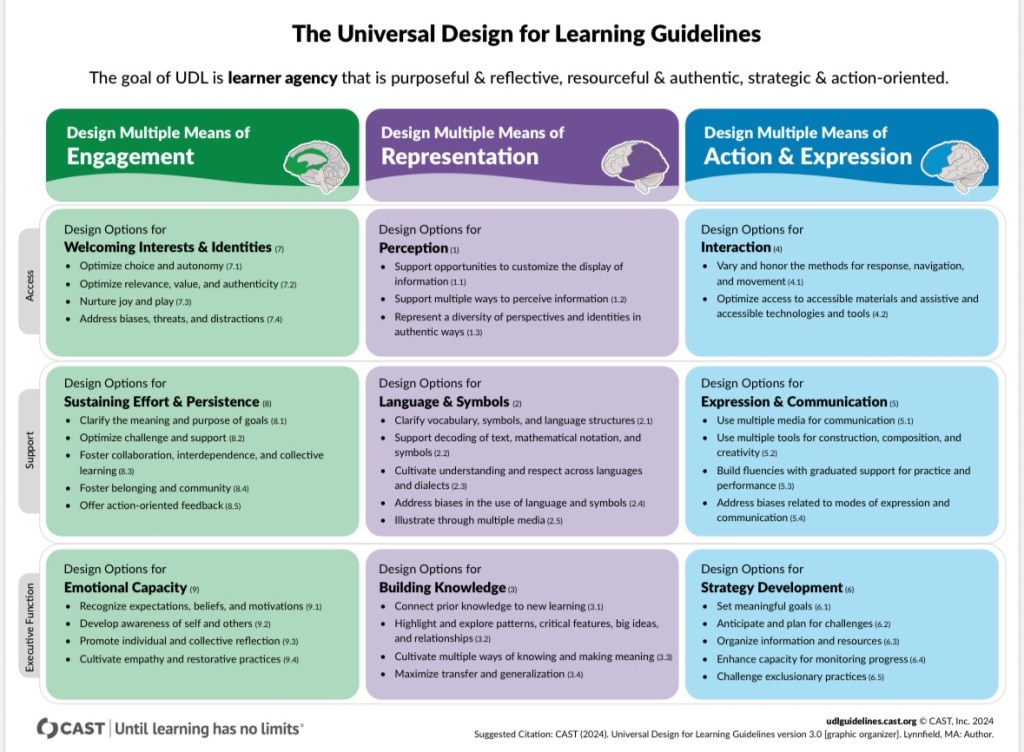
Over the past nine years, I’ve had the privilege of teaching Health Science courses at the high school level. In that time, I naturally began applying principles from Universal Design for Learning (UDL)—often without knowing there was a formal name for what I was doing. From offering students multiple project formats to fostering collaborative, technology-driven environments, UDL has helped me engage a wide range of learners with diverse needs and strengths.
Now, as I prepare to step into a new role as an elementary school librarian, I’m reflecting on how to carry these strategies into a completely different teaching context. The UDL framework provides a powerful structure for that transition—one that supports not just classroom teachers, but teacher-librarians, too.
What I’m Already Doing Well (in High School Classrooms)
Access & Action/Expression
In my Health Science classes, I offered multiple means of expression for projects: written essays, group presentations, short videos, digital posters, and even creative options like songs or skits. I provided instructions and rubrics both in print and on Canvas, knowing that high schoolers often lose handouts and appreciate being able to access assignments digitally.
Support
I clarified expectations with detailed rubrics, allowed students to choose between solo or partner work, and encouraged collaboration through tools like Canva and Office 365. These choices gave students ownership of their learning and fostered engagement, especially when paired with real-world applications.
Executive Function
I designed opportunities for students to self-evaluate their work, make connections to prior learning, and track progress toward their goals—particularly when preparing for health certifications or career-aligned projects.
What I Can Add to My Practice (Starting Now)
Looking ahead to my first year as an elementary librarian, I see immediate ways to grow my UDL practice:
- Language & Symbols (2): I plan to clarify key terms, offer visual aids and multimodal representations, and provide linguistic access for early readers and multilingual students. I also want to be mindful of how different dialects and backgrounds show up in children’s literature and conversations.
- Emotional Capacity (9): I aim to help younger students recognize their feelings, develop empathy, and reflect on their experiences through read-alouds, social-emotional learning tie-ins, and restorative practices. This will support the library as a safe and inclusive space.
What I Might Need Help With
- Sustaining Effort and Persistence (8): In a flexible library setting, I want to learn how to optimize challenge without overwhelming students, especially when they’re trying something new like research, coding, or digital storytelling. I also want to support collective learning while promoting perseverance in early readers and students with learning differences.
- Strategy Development (6): Helping students, especially younger ones, set meaningful goals, plan for challenges, and monitor their progress will be new territory. I’m excited by the idea, but I know I’ll need scaffolds and maybe a mentor librarian who’s doing this well already.
What I Want to Explore Further
As I shift from a content-area high school teacher to an elementary librarian, I’m particularly interested in how the UDL framework can transform the library into a dynamic, inclusive learning hub. I don’t just want to be a gatekeeper of books—I want to be a facilitator of discovery and student voice.
One metaphor that’s stuck with me is Katie Novak’s “Dinner Party” analogy (Novak Education Blog). She compares UDL to designing a dinner party where everyone has access to food they can enjoy, rather than providing one standard meal with dietary accommodations added as an afterthought. This analogy beautifully illustrates the difference between proactively planning for learner variability (UDL) and reactively differentiating instruction (DI). It helps me think about how to design library lessons from the ground up with diverse learners in mind, rather than adjusting after the fact.
Additionally, the article “Universal Design for Learning and the Quality Matters Guidelines” offers insights into how UDL connects to broader instructional quality measures. Though it focuses on higher education, it makes a compelling case for embedding UDL into the design phase of instruction—something I plan to carry into book clubs, makerspace activities, and inquiry-based library projects.
I’m also diving into the UDL Guidelines Graphic Organizer (CAST, 2024) from udlguidelines.cast.org, which helps break down UDL checkpoints into actionable strategies. It’s already sparking ideas for read-alouds that feature multiple perspectives (Access 1.3), research projects with scaffolded collaboration (Support 8.3), and student-created book reviews using varied formats (Action & Expression 5.1–5.2).
Next Steps:
- Connect with other librarians who are using UDL (especially in my district or through #FutureReadyLibs).
- Pilot a project in the library with choice-based expression—maybe a genre exploration where students share their favorites using drawings, videos, or puppet shows.
- Begin developing lesson templates that include embedded UDL strategies for teachers to co-plan with me.
Transitioning into a new role is always exciting and a little overwhelming, but UDL provides a roadmap. I know from experience that choice, clarity, and collaboration empower learners. Now, I’m eager to see how those same values will shape my work in the library—and how I can grow alongside my students in the process.


 Gwinn Reads
Leave a reply to Kayla Michna Cancel reply