A Reflection on Teaching in the Age of Exponential Change
In my former life as a high school Health Science teacher, one of the most eye-opening conversations I had with students revolved around continuing education—and why it’s not just a requirement for healthcare professionals, but a necessity for everyone in a world shaped by rapid technological change.
To bring this concept to life, I would ask students to take out their phones and check how much memory they had. Some would even compare their smartwatches. Then, I’d tell them about my first college computer—an Acer Aspire with a whopping 820 kilobytes of memory—and before that, an Apple IIe that was little more than a glorified word processor.
Cue the surprised faces.
I’d explain that a single photo taken on their phones today is larger than the entire memory of my college computer. The fact that they carry more computing power on their wrists than I had in an entire desktop setup never failed to spark some laughs—and a few age-related jokes at my expense. But those moments opened the door to a deeper conversation: about how quickly technology evolves, and how our teaching practices must evolve alongside it.
From the 1990s to the 2020s, technological advancement has not just progressed—it has exploded. And as educators, we can’t afford to treat technology as an add-on or afterthought. It’s a central part of how students live, learn, and connect. That understanding must shape how we design learning experiences, how we build digital literacy, and how we prepare students not just for today’s tools, but for tomorrow’s possibilities.
To truly engage today’s students, we have to start by understanding how they see the world—and how that differs from our own perspective. The Mindset List, originally developed by Beloit College and now published by Marist University, offers a powerful snapshot of this generational shift. With 60 striking examples, it highlights how the current generation of students has grown up in a world fundamentally different from the one their educators experienced. Take a look at it, it is truly mind-opening.
These differences aren’t just interesting trivia—they have real implications for pedagogy. Today’s students have never known a world without Wi-Fi, GPS, or smartphones. They assume instant access to information and expect real-time feedback. For them, long-distance calls have always been free, the internet has always been mobile, and learning often looks more like YouTube tutorials than printed textbooks.
As educators, it’s not our job to lament these differences but to adapt to them. We must meet students where they are, not where we wish they were. By aligning our instruction with their lived experiences, digital habits, and cultural references, we make our lessons not only more engaging, but more meaningful. Relevance is the bridge between content and connection—and when students feel that what they’re learning resonates with their world, they’re far more likely to retain and apply it.
Technology in the classroom should never be used just for the sake of using it. Instead, it should serve a dual purpose: to enhance learning and to connect students to content, to each other, and to the world beyond the classroom.
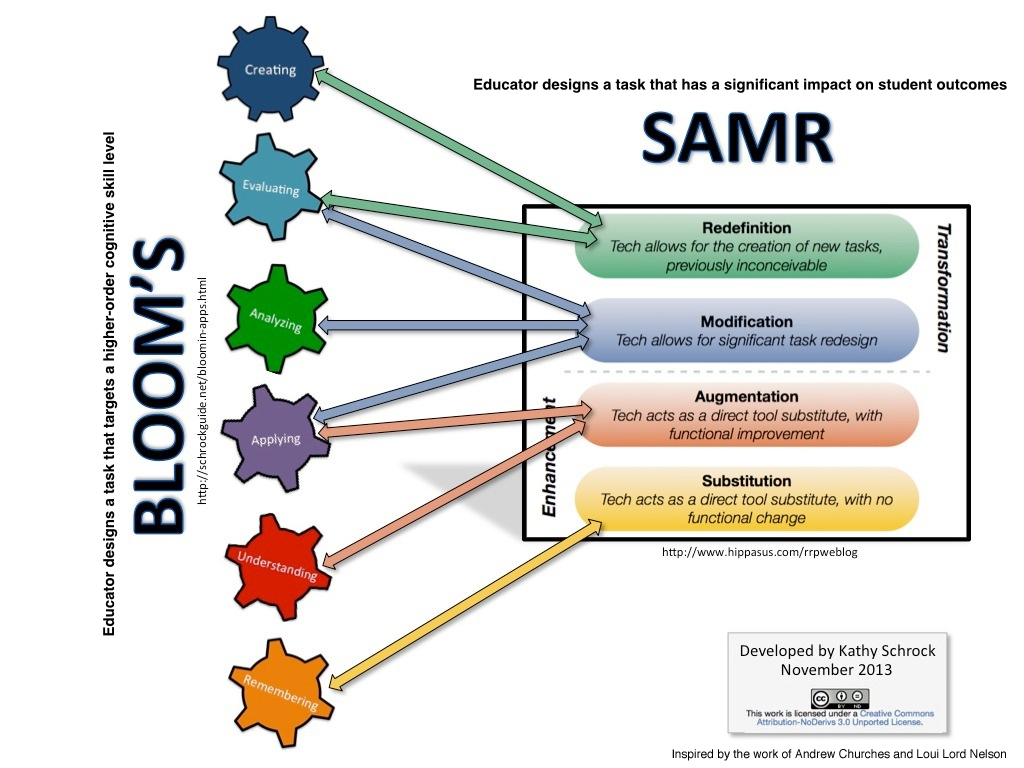
Frameworks like Bloom’s Digital Taxonomy and the SAMR model help us evaluate how technology can support deeper, more meaningful learning. Whether you visualize Bloom’s as a pyramid, a set of interlocking gears, or even slices of an orange, the message is the same: technology can play a role at every level—from remembering and understanding to creating and evaluating. For instance, a student might begin by using a quiz app to recall key facts, then move on to designing an interactive infographic to analyze and present information to their peers.
The SAMR model—Substitution, Augmentation, Modification, and Redefinition—pushes us to think critically about how we use tech. At the basic level, we might use technology to substitute a paper worksheet with a digital one. But the true power of technology is unlocked when we move into modification and redefinition—when students can collaborate in real time, create multimedia projects, or engage with audiences beyond the classroom walls.
Kathy Schrock’s interpretation of SAMR highlights how this model isn’t meant to be linear, but reflective. Her approach encourages educators to make intentional choices that align technology use with learning goals. When we thoughtfully consider how a tool supports pedagogy, we shift from using tech because it’s available to using it because it matters.
As aspiring librarians, our role is shifting just as rapidly as the technology we’re asked to support. Gone are the days when the school library was simply a quiet place for books. Today, it is a hub of inquiry, collaboration, digital citizenship, and innovation. With that shift comes the responsibility to wisely choose technology—not just what’s new or flashy, but what’s purposeful, accessible, and aligned with instructional goals.
One of the most important things we can do is partner with teachers to help them integrate technology into their curriculum with intention. This means understanding both the tools themselves and the pedagogy behind them. It means recognizing when technology enhances a lesson and when it becomes a distraction. And it means being able to recommend the right tools for the right tasks—tools that help students research more deeply, think more critically, and create more meaningfully.
As librarians, we become instructional collaborators—helping teachers map technology onto standards, differentiate for learners, and build lessons that foster creativity, inquiry, and engagement. We can use models like SAMR to guide these conversations, showing how simple substitutions can evolve into transformative learning experiences. We don’t have to be experts in every app or device, but we do need to be leaders in thoughtful integration, ensuring that technology in our schools serves students first and foremost.
From student mindset to lesson design to collaborative leadership, technology isn’t just a layer we add—it’s a lens we teach through. Tools and trends will continue to change, but our commitment to purposeful, student-centered learning must remain steady.
By understanding how students view the world, using technology to enhance learning at all levels, and stepping into leadership roles as librarians and instructional partners, we can ensure that our schools remain places of curiosity, relevance, and growth.
As Kathy Schrock’s SAMR model reminds us, the goal is not to use technology at its highest level all the time—but to reflect on when and how it supports deep, meaningful learning. Technology is a bridge—not a destination—and when we choose our tools with care and our teaching with purpose, we prepare students not just to consume the world around them, but to shape it.
References:
Bloom’s digital taxonomy. Common Sense Education. (n.d.). https://www.commonsense.org/education/videos/blooms-digital-taxonomy
Churches, A. (2008, January). Bloom’s Digital Taxonomy.
Digital Transformation | K-12 Blueprint. (n.d.). https://www.k12blueprint.com/toolkits/digital-transformation
The first Marist Mindset List is released. Marist University. (n.d.). https://www.marist.edu/w/marist-news-the-first-marist-mindset-list-is-released
Schrock, K. (2025, February 12). SAMR and Bloom’s.

 Gwinn Reads
Leave a reply to Sophia Carmona Cancel reply