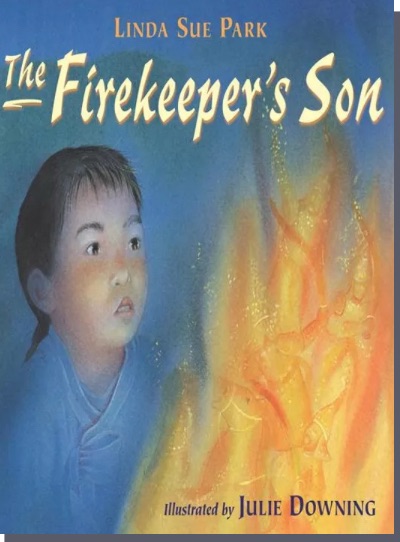
Park, L.S. THE FIREKEEPERS SON. (2009). Ill. by Downing, J. Clarion Books. ISBN 978-0547237695
The Firekeeper’s Son offers a fascinating glimpse into a piece of Korean history through the eyes of a young boy facing a timeless dilemma: doing what’s right versus doing what he wants. The story follows Sang-hee, the son of a village firekeeper responsible for lighting a signal fire on the mountainside, part of an important communication system that alerts the king’s army about threats along the coast. When Sang-hee’s father is injured, the duty falls to him, and he hesitates, torn between his longing to witness soldiers up close and his responsibility to keep his people safe.
Linda Sue Park tells the story with warmth and tension, creating a moment of choice that feels relatable to young readers. Children everywhere know the pull of personal desire against duty, making Sang-hee’s internal struggle easy to connect with. The narrative also offers a quiet but powerful look at honor, responsibility, and the ripple effects of our decisions.
Julie Downing’s illustrations are stunning, immersing readers in the Korean landscape with rich colors and textured detail. The mountains, village, and dramatic night sky are beautifully rendered, evoking both the intimacy of Sang-hee’s thoughts and the vastness of the world he’s connected to through his actions. The illustrations authentically depict 19th-century Korea, grounding the story in a culturally accurate setting.
Culturally, The Firekeeper’s Son celebrates Korean heritage by highlighting a historical system of mountaintop signal fires and the communal responsibility behind them. Sang-hee and his family are portrayed with authenticity and depth, free of stereotypes, and the story integrates cultural details naturally—through landscape, dress, and values of duty and family honor. It’s an affirming depiction of historical Korea that also offers universal themes.
From a justice and equity perspective, the book encourages empathy by helping readers understand the importance of communal responsibility and the sacrifices individuals sometimes make for the greater good. It’s a story that invites discussion about how our actions can affect others, even in ways we can’t always see.
For educators and librarians, this book is an excellent choice for lessons on cultural history, character education, and moral decision-making. It pairs well with social studies units on historical communication systems or Asian history and can prompt deeper conversations about personal integrity and family responsibility.
Related Books:
- A Single Shard by Linda Sue Park
- Nim and the War Effort by Milly Lee
- The Name Jar by Yangsook Choi
- Bee-bim Bop! by Linda Sue Park
- The Royal Bee by Frances Park
Classroom or Library Activities:
- Signal Fire Simulation: Have students create a “communication chain” using flashlights or paper signals to see how messages travel across distances.
- Decision Dilemmas: Discuss moments when students had to choose between what they wanted and what they needed to do. Create a class chart of “hard choices.”
- Cultural Research Project: Explore the history of Korea’s signal fire system. Have students create maps showing how fires were used for communication.
- Art Connection: Study Julie Downing’s use of color and light. Have students create their own artwork depicting a nighttime scene that tells a story.
- Storytelling Circle: Encourage students to retell the story in their own words, emphasizing Sang-hee’s inner conflict and decision.
The Firekeeper’s Son is both a window into Korean history and a mirror reflecting children’s everyday experiences with tough choices. With its beautiful illustrations and universal themes, it’s a story that sparks meaningful conversations about duty, family, and the quiet courage of doing what’s right—even when it’s hard.
 Gwinn Reads
Leave a comment