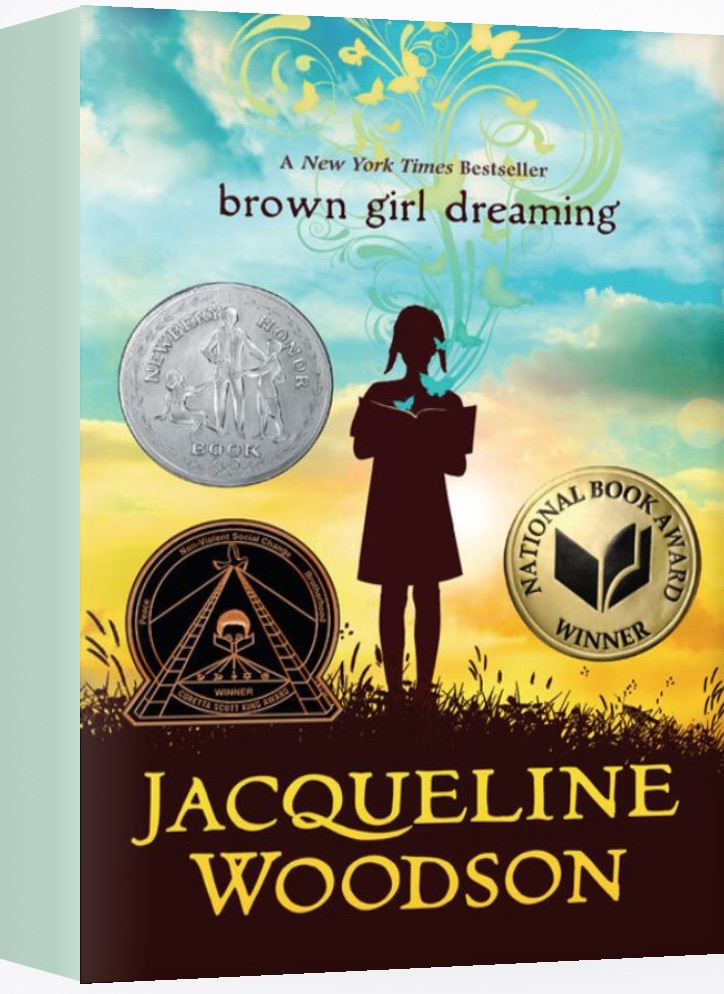
Woodson, J. BROWN GIRL DREAMING. (2014). Nancy Paulsen Books. NY, NY. ISBN 978-0-69819-570-7.
I think I must stop saying I don’t enjoy poetry—at least when it comes to prose poetry. There’s something about the way it flows, how it gives space for reflection and emotion, that just draws me in. Brown Girl Dreaming is no exception. In fact, this book made me feel deeply connected to the author’s voice, her memories, and her journey. It’s raw, heartfelt, and incredibly poignant in its honesty. I could understand her point of view in so many places, even though our experiences are very different.
Told through verse, Brown Girl Dreaming is Jacqueline Woodson’s memoir of growing up as a young Black girl in the 1960s and 70s, split between South Carolina and Brooklyn. The poems trace her early life, her growing awareness of the world, and her discovery of writing as her own personal freedom and power. What’s so compelling is that Woodson doesn’t just tell her story—she invites you into her memories, one poem at a time, layering emotion and reflection with every line.
The characters are rich and authentic. Jacqueline herself is portrayed with depth and vulnerability—from her uncertainties as a young girl to her quiet determination to find her voice. Her family members—her mother, grandparents, siblings—are presented with love and complexity, never one-dimensional. They reflect a variety of experiences, values, and beliefs within Black communities. These characters feel lived-in, not idealized, and they reflect a range of physical, emotional, and intellectual attributes that challenge stereotypes.
The setting plays a huge role in the memoir. The contrast between the segregated South and the bustling city life of Brooklyn is powerful and constant. Through Woodson’s eyes, we see how geography, history, and culture shape identity. These details—whether it’s a front porch in Greenville or a neighborhood block in New York—are deeply connected to her experiences.
Cultural values are woven throughout the book with care and honesty. Woodson shares family traditions, language, religion, and the complexities of growing up during the civil rights movement. There are moments of beauty, pride, tension, and questioning. The text offers insight into African American experiences across two different regions and generations, while also highlighting universal feelings of belonging, difference, and becoming. It celebrates diversity through small, everyday moments that shape a life.
This book more than meets the standards for literary quality. It’s accessible, reflective, and deeply engaging. The verse format gives space for breath and emotion. Readers can linger on a thought or fly through several pages—either way, the storytelling is masterfully done. For readers who might be unsure about poetry, this is a perfect introduction to how powerful prose poetry can be. The format and content invite rich discussion and personal response, especially in middle and high school classrooms or book clubs.
Brown Girl Dreaming has been widely celebrated, and for good reason. It received the 2014 National Book Award for Young People’s Literature, the Coretta Scott King Award, and a Newbery Honor—a rare trifecta that speaks to both its literary excellence and its cultural significance. It has also been named a New York Times Bestseller and included in countless recommended reading lists for young people.
Connections and Follow-Up Activities
Related books:
- Inside Out and Back Again by Thanhhà Lai (also a verse memoir)
- Free Verse by Sarah Dooley
- How I Discovered Poetry by Marilyn Nelson
- Piecing Me Together by Renée Watson (for older readers)
- The House You Pass on the Way by Jacqueline Woodson
Classroom or Library Activities:
- Memoir in Verse: Have students write their own short memoir poems. Encourage them to focus on a single moment, sound, or memory that shaped who they are.
- Then vs. Now Setting Map: Compare the South and Brooklyn in Jacqueline’s life—what did each place represent to her? Create a visual chart or mind map.
- Cultural Snapshot Collage: Using clues from the book, students can create visual or written “snapshots” of cultural moments (music, food, church, hair, language) that stood out to them.
- Quote Reflection: Use powerful lines from the book as writing prompts or discussion starters (e.g., “Even the silence has a story to tell you…”).
- Book Club Comparison: Pair this book with another memoir or historical novel. Discuss how identity and place shape each author’s experience.
Brown Girl Dreaming is the kind of book that stays with you. It’s gentle and strong, full of memory and meaning. For students, it’s an invitation to explore their own stories. For educators and librarians, it’s a powerful tool for conversations about identity, race, history, and the power of words. Whether you already love poetry—or think you don’t—this book might just change your mind. It did for me.
 Gwinn Reads
Leave a comment