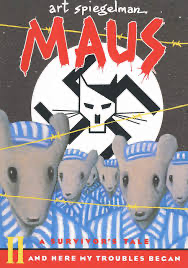
Spiegelman, A. (1986). Maus I: A Survivor’s Tale: My Father Bleeds History. Pantheon. ISBN 978-0394747231.
Reading Maus I: A Survivor’s Tale again after all these years has given me a deeper understanding of both the Holocaust and the power of graphic novels as a medium for serious storytelling. The first time I encountered this work was during my undergrad years while studying German history, and back then, I appreciated it for its historical context and its stark portrayal of the survivor experience. But revisiting the book with new eyes, I realize just how much it does beyond merely recounting the horrors of the Holocaust.
Art Spiegelman’s Maus is a unique blend of memoir, history, and graphic storytelling, presenting the story of his father, Vladek Spiegelman, a Jewish Holocaust survivor, through the lens of animal allegory. Jews are depicted as mice, Germans as cats, Poles as pigs, and so on, creating a visual shorthand that, while lightening the burden of representation, never trivializes the gravity of the subject matter. The anthropomorphic approach initially seems playful, but as the narrative deepens, it serves as a subtle tool for helping the reader digest the unimaginable suffering without losing sight of the human experience behind the horror.
As an undergrad, I understood the historical weight of the narrative and the importance of Vladek’s personal testimony as a piece of historical documentation. But now, reading it as an adult, I see how much Maus is also a reflection on trauma, memory, and intergenerational wounds. Art’s complex relationship with his father adds a layer of tension to the book, revealing how the trauma of the Holocaust extends beyond those who lived through it and affects the generations that follow. The father-son dynamic—frustrating, painful, and occasionally humorous—brings a human dimension to a story that could easily slip into abstraction.
One of the most remarkable aspects of Maus is how it balances its dark subject matter with a visual style that is deceptively simple. The stark black-and-white illustrations, while not overtly graphic in the way one might expect from stories of war and violence, do an incredible job of portraying the emotional and physical toll of the Holocaust. The images of mice scurrying in the dark or of the ominous, towering figures of cats speak volumes without the need for over-explanation. The visual metaphor allows readers to process the traumatic history in a way that text alone might not achieve.
Reading Maus again now, I see more clearly how it also explores the complexities of survival. Vladek’s survival instincts, at times seemingly abrasive or difficult to understand, reflect the way in which trauma shapes a person’s behavior long after the immediate threat has passed. His obsession with money, his inability to form close relationships, his paranoia—all these traits are understandable in the context of his horrific experiences, yet they also create an emotional distance between him and his son, Art. The cyclical nature of trauma is painfully evident, and Maus doesn’t offer easy answers or neat resolutions. It is a story of survival, yes, but it is also a story of the toll survival takes on the human spirit.
In conclusion, Maus is more than just a historical account or a graphic novel; it is a haunting meditation on memory, loss, and the lingering effects of trauma. As I revisited it with the benefit of time and maturity, I found that the book spoke to me on a deeper level than it did during my undergraduate years. While its visual style might seem lighthearted on the surface, the depth of its storytelling and its emotional resonance are profound. Maus is a work that endures because it gives us a way to process history and the human condition in a manner that is both accessible and unflinchingly honest.
 Gwinn Reads
Leave a comment