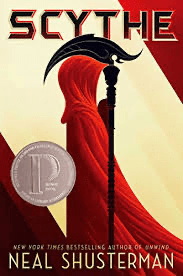
Shusterman, N. (2016). Scythe. Simon & Schuster Books for Young Readers. ISBN 978-1442472433.
Scythe by Neal Shusterman presents an intriguing and thought-provoking take on a dystopian future, where death no longer exists due to advancements in science and technology. In this world, a group of individuals known as Scythes are tasked with “gleaning” — or killing — to maintain population control. It’s a chilling concept, but Shusterman explores it with depth and complexity, raising questions about morality, power, and the nature of life and death.
The story follows two protagonists, Citra and Rowan, who are selected as apprentices to a Scythe named Faraday. The contrast between the two characters is one of the most compelling aspects of the novel. Citra is a morally driven young woman with a strong sense of justice. She struggles with the idea of taking life, even as she’s forced to learn the craft of gleaning. Her internal conflict forms the emotional core of the book, as she wrestles with her personal ethics and the role she must play in a society where death is no longer a natural part of life.
Rowan, on the other hand, is more reserved, and as the novel progresses, there’s a growing sense of unease surrounding his character. While you want to like him — and perhaps even root for him — there’s a persistent sense of ambiguity about his motives. His transformation throughout the story keeps readers on edge, and his eventual actions raise difficult questions about morality and survival in a world devoid of true consequences.
The dynamic between Citra and Rowan is fascinating. They both represent different aspects of human nature when confronted with power, death, and the loss of free will. Citra embodies the moral struggle, while Rowan grapples with the temptation of power and what it means to take control of his own fate. The tension between them is palpable, and the way their relationship evolves adds a layer of complexity to the narrative.
The world-building in Scythe is also noteworthy. Shusterman creates a society that feels both futuristic and unsettlingly plausible, where advancements in science have erased the concept of death, leading to a society that is, in many ways, stagnant and apathetic. The Scythes are meant to be impartial judges, but as the story unfolds, it becomes clear that even in a world where death has been normalized, power dynamics and corruption still exist.
By the time I reached the end of Scythe, I was so hooked that I had to immediately get the rest of the series and finish it, so I knew what happened next! The stakes get higher, the twists and turns more unexpected, and the characters become even more complex. Shusterman manages to keep the tension going throughout the entire trilogy, making it impossible to put down once you’ve started.
Overall, Scythe is a gripping and thought-provoking novel that explores the moral consequences of immortality, the nature of power, and the human desire for control. The characters are richly developed, with Citra and Rowan serving as a study in contrasts, each facing a different but equally challenging path. Shusterman’s ability to craft a compelling narrative while delving into complex ethical dilemmas makes Scythe a standout in the dystopian genre.
If you’re looking for a story that challenges your ideas about life, death, and morality, Scythe is a must-read. It’s a novel that keeps you questioning long after you turn the last page—and if you’re like me, you’ll be eager to dive right into the rest of the series!
 Gwinn Reads
Leave a comment